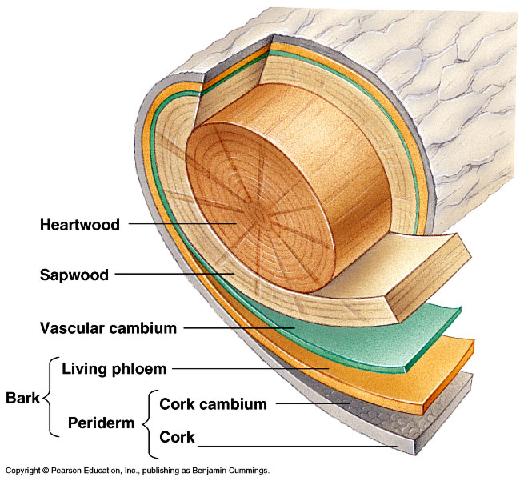
Just look at a Plants stalk. The
woof protects the inner wood from climate, insect and other danger. Just inside the woof there is a skinny layer called the
cambium, whose cells turn out to be both woof and internal wood. Next is
sapwood, which carry beneficial sap throughout the tree the same way our blood flows all the way through our bodies to nourish us.
Heartwood is the deepest part of the stalk, and even though it is not living, it provide the tree with potency and structure.
If you actually want to be familiar with paper and paper-making, you have got to get to know about plants.
Trees & Plants are all around you. But have you ever really
consideration about how they are put mutually? They are pretty cool.
All that lumber material is shaped of fibbers, small fiber strands stuck jointly with a ordinary adhesive material called lignin. It is by sorting out and reorganizes those fibbers that we make paper.
Consider the source
Several papers are made from brand-new trees – either tiny trees
harvest just for that principle, or from sawmill knock-knacks left over
when larger trees are made into lumber. A next source of paper-making
substance is used fiber. Every year, many more paper are recycled – its fibbers is used for second, third or fourth times.
More or less all of the paper you use nowadays is finished of wood
fibbers. Some specialty papers, like stationery and currency, are made
from linen, cotton, or other plants. Other papers contain a mixture of
roughage fibers and synthetics such as latex. Still others are made
completely from synthetic materials such as poly-olefin. You might find
latex in a water-resistant mariner’s chart, or poly-olefin in a rugged
courier envelope. But you’ll find natural fiber paper almost everywhere!
 Lumber is wood?
All tree species grows a certain way, and that affects the way its wood
looks and performs. Foresters separate trees into two categories: hardwood and softwood species.
Hardwood trees: It’s
such as oaks and maples have wood with very short fibbers. Paper made
from this type is weaker than that made from softwoods, but its surface
is smoother, and therefore better to write and print on.
 Softwood trees:
It’s
such
as pine and spruce have wood with extended fibers, and paper made from
this type of wood is much stronger. This paper is ideal for creation
produce like shipping containers that require higher strength. But the
finish is rougher, and that’s not as good quality for script, printing
and lots of other uses.
We create newspaper to be opaque (that means that troublesome to
visualize through) – therefore you simply see the newspaper’s comics,
not the securities market report on the opposite side!
We create poke paper sturdy, tissue soft, fine paper sleek. Even inside
an equivalent class there is quite vary. Among printing papers, for
instance, compare the skinny sheets of a Bible to the thick, robust
pages of a kid’s volume.
The basic instruction – wood, water and energy – is adjusted to create simply the paper that is required.
First, workers harvest trees, principally from special tree-growing
areas known as tree farms. When the trees area unit removed, additional
trees area unit planted in their place. Whereas they’re growing, the
young trees turn out several gas, and supply nice home ground for
ruminant, quail, turkeys and alternative life.
The logs area unit transported to the paper company wherever they get
a shower to rinse away dirt and alternative impurities before being
became little chips of wood. The chips area unit then sorted in line
with size, and moved to the pulping operation, wherever they’re going to
be became pulp for creating paper.
In
the pulping stage, the individual wood fibers within the chips should
be separated from each other. This will be accomplished victimisation
one or additional pulping techniques. the sort of paper that is being
created determines the pulping method that’s used. The finished pulp
sounds like a mushy, watery resolution. However if you scrutinize it
beneath a magnifier, you may see that the individual wood fibers have
all been separated.
Now it is time to form paper out of our pulp. That primarily means
that obtaining the water out of the wood-fiber soup, since this trade
stock is regarding water. The primary space within which this takes
place is named the wet finish of the trade machine.
First, paper-makers spray the stock onto an extended, projection
screen, known as a wire. in real time, water begins to empty out very
cheap of the wire. This water is collected in order that it will be
reused over and another time. Meanwhile, the pulp fibers square measure
caught on the highest facet of the wire, and start to bond along in an
exceedingly} very skinny mat. The fiber mat remaining on the wire is
then squeezed between felt-covered press rollers to soak up additional
of the water.
Even once this wet finish work is over, the non woody stuff on the
wire continues to be regarding hour water. However currently it is time
for the dry finish.
In the dry finish, vast metal cylinders are heated by filling them
with steam. The wet paper, which may be up to thirty feet wide, passes
through these hot rollers – generally dozens of them, and sometimes in 3
to 5 teams. Heating and drying the wet sheet seals the fibers nearer
and nearer along, turning them step by step from pulp into paper.
When you investigate a chunk of paper, are you able to notice any
distinction in thickness in this single sheet? Most likely not, due to a
neighborhood of the paper machine referred to as the calendar –
massive, serious forged iron rollers that press the drying paper sleek
and uniform in thickness. Sometimes the paper is coated, usually with
fine clay, to create it glossier and easier to print on. A bit
additional drying then rolled onto an enormous spool or reel, the pulp –
a miraculous mat of fibers from trees – has become paper, prepared for
cardinal uses.
 The paper industry
is an international business concerned in the manufacture of paper and
paper goods. Paper is formed by processing wood into thin sheets that
can then be used in business, communications, shipping and pursuit.
Major businesses in the paper trade may own tree farms, wood processing
services, paper manufacturing factories, or a grouping of any of these.
Paper goods have a wide diversity of uses and can be found almost
everywhere in developed nations.